What Are Terpenes? A No-BS Guide to Cannabis Flavor & Aroma

Cannabis does not smell “like cannabis” by accident. That piney snap, citrus peel punch, peppery bite, fuel-ish funk, lavender sweetness, and mango-ripe softness come from a family of plant compounds called terpenes.
They are not decoration. They are not marketing glitter sprinkled on a jar label so someone can charge more. Terpenes shape the aroma and flavor of cannabis in a very real, measurable way. They also help explain why two products with the same THC percentage can smell, taste, and feel different.
That does not mean terpenes are magic medicine. The research is interesting, but the internet has a nasty habit of turning “early lab finding” into “this terpene cures your entire personality.” Let’s not do that.
Here is the clean version: terpenes are aroma compounds found all over nature, cannabis makes many of them, and terpene profiles can be useful when choosing cannabis products, especially if flavor and overall experience matter to you.

What terpenes are and where they show up in nature
What are terpenes? They are a large class of natural compounds made by plants, fungi, and some insects. Chemically, classic terpenes are built from isoprene units, which are small five-carbon building blocks. Terpenoids are closely related compounds that often contain oxygen. In everyday cannabis talk, people usually use “terpenes” as a catchall for both.
Nature uses terpenes constantly. You know them already, even if you never learned the name.
Terpenes help give:
Lemons their bright citrus smell
Pine forests their sharp resin scent
Lavender its soft floral aroma
Black pepper its spicy kick
Hops their herbal, bitter edge
Rosemary its clean, woody bite
Mangoes some of their ripe tropical character
Plants do not make terpenes to impress humans sniffing jars at a dispensary. Rude, but fair. In plants, terpenes can help attract pollinators, defend against pests, respond to stress, and communicate with the surrounding environment.
In cannabis, terpenes are produced mainly in the plant’s resin glands, called trichomes. Those same sticky structures also produce cannabinoids such as THC and CBD. That is why well-grown cannabis flower can smell loud before it ever touches heat.
Terpenes are volatile, which means they evaporate easily. This is why aroma can fade during poor storage, rough drying, high heat, or long exposure to air and light. If a product smells flat, stale, or like old hay, the terpene profile may have taken a beating.
How terpenes create cannabis aroma and flavor
Terpenes in cannabis work like the aromatic fingerprint of a cultivar, often called a strain. THC percentage tells you one thing. Terpenes tell you another. The nose knows more than the potency number, which is inconvenient for people who want one simple scoreboard.
Cannabis aroma comes from a mix of compounds, not just one terpene doing a solo act. Terpenes play a major role, but researchers have also identified other volatile compounds that contribute to cannabis’s skunky, savory, fruity, or fuel-like notes. So if a flower smells like lemon-diesel-pepper-garlic chaos, that is chemistry, not your imagination.
Flavor follows aroma closely because much of what people call “taste” is actually smell. Your tongue detects basics like sweet, sour, bitter, salty, and umami. Your nose does the heavy lifting on the lemon, pine, grape, pepper, floral, or earthy details.
That is why cannabis can taste muted if it has lost aroma. It is also why vaporizing at lower temperatures often preserves more flavor than burning flower hotter than a tiny campfire. Combustion has its charms for some people, but subtle terpene appreciation is not exactly its strongest personality trait.

Common cannabis terpenes and their characteristic aromas
Cannabis can contain dozens of terpenes, and the mix varies by genetics, growing conditions, harvest timing, drying, curing, storage, and processing. Here are some common terpenes and the aromas they are best known for.
Terpene | Aroma character | Also found in |
Myrcene | Earthy, musky, herbal, sometimes clove-like | Hops, mango, lemongrass, thyme |
Limonene | Citrus peel, lemon, orange, bright and zesty | Citrus rinds, juniper, peppermint |
Beta-caryophyllene | Peppery, woody, spicy, dry | Black pepper, cloves, oregano |
Pinene | Pine, resin, fresh forest air | Pine needles, rosemary, basil |
Linalool | Floral, lavender, soft, slightly sweet | Lavender, coriander, basil |
Humulene | Woody, earthy, hoppy, herbal | Hops, sage, ginseng |
Terpinolene | Fresh, herbal, floral, sometimes fruity | Tea tree, nutmeg, cumin, lilac |
Ocimene | Sweet, green, tropical, slightly woody | Mint, parsley, orchids, mango |
Geraniol | Rose-like, floral, sweet | Geraniums, roses, citronella |
Bisabolol | Light floral, honeyed, chamomile-like | Chamomile, candeia tree |
Myrcene often brings the earthy bass note
Myrcene is one of the most discussed cannabis terpenes. Its aroma can read as earthy, musky, herbal, or slightly spicy. In some cultivars, it helps create a ripe, heavy, almost tropical smell. In others, it sits in the background like a low note in a song.
You may see confident claims that myrcene automatically causes strong sedation. That claim is too neat. Some preclinical research has explored myrcene’s biological activity, but translating that into a predictable effect from a cannabis product in a person is a much bigger jump.
Limonene gives citrus its bite
Limonene smells like citrus peel, especially lemon and orange rind. It can make cannabis feel brighter on the nose, even when the flower also has diesel, pine, or herbal notes.
Limonene is common in many plants and appears in cleaning products, fragrances, and foods because humans apparently enjoy smelling like we just wrestled a lemon grove. In cannabis, limonene is mainly useful as an aroma and flavor marker. Research into possible biological effects exists, but product-level claims should stay modest unless supported by human data.
Beta-caryophyllene is the spicy oddball
Beta-caryophyllene smells peppery, woody, and dry. It is common in black pepper and cloves. It also has an unusual trait: it can interact with the CB2 receptor, part of the body’s endocannabinoid system.
That makes beta-caryophyllene especially interesting to researchers because most terpenes are not known for directly binding cannabinoid receptors in the same way. Still, “interesting receptor activity” is not the same as a proven health benefit from a retail cannabis product. Biology is not a vending machine.
Pinene brings the forest
Pinene smells like pine needles, resin, rosemary, and clean green air. There are two main forms, alpha-pinene and beta-pinene, both found widely in nature.
In cannabis, pinene can sharpen the aroma and add a crisp top note. Some early research has explored pinene in relation to inflammation, memory, and airway effects, mostly outside cannabis-specific human studies. Treat those ideas as preliminary, not as shopping instructions.
Linalool softens the edges
Linalool is best known for its lavender-like floral aroma. It can add a soft, sweet, slightly powdery note to cannabis.
Linalool has been studied in aromatherapy and pharmacology contexts, but cannabis products are chemically complex. A linalool-rich product is not the same thing as lavender essential oil, and neither should be treated as a medical treatment without proper evidence.
Why terpene profiles matter when choosing cannabis products
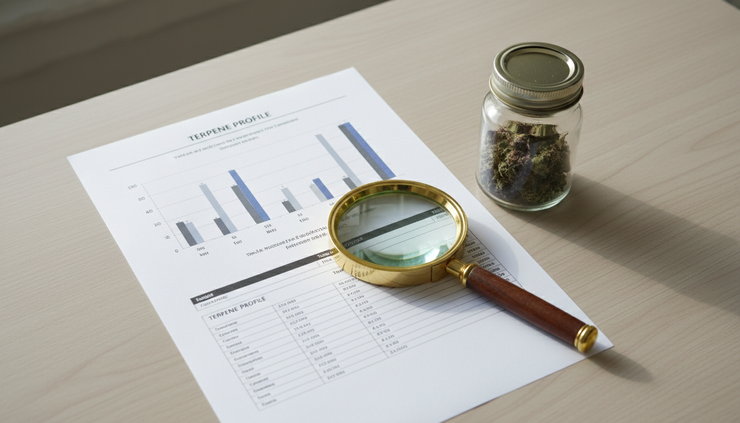
A terpene profile is the lineup and relative amount of terpenes in a cannabis product. Lab-tested products may list dominant terpenes on the certificate of analysis, often called a COA. Some brands also print the top terpenes on packaging.
Terpene profiles matter because they can help you choose based on more than THC percentage. That matters a lot, because THC percentage alone is a blunt tool. Sometimes literally.
A terpene profile can help you predict:
Whether the product may smell citrusy, earthy, floral, gassy, spicy, piney, or sweet
Whether two products with similar THC levels may offer different sensory experiences
Whether a product matches flavors you already like in food, herbs, or drinks
Whether the cannabis was handled well enough to preserve aroma
For flower, fresh aroma is often a decent quality clue. Not perfect, but useful. For vapes, concentrates, and infused products, terpene profile can tell you whether the flavor comes from cannabis-derived terpenes, botanical terpenes, or added flavoring. Those are not automatically good or bad, but they are different.
Here is the practical move: pay attention to the terpenes you enjoy, not just the cultivar name. Names can be messy. Genetics can drift. One “Blue Whatever” may smell nothing like another “Blue Whatever.” Lab results and your own nose are better guides than folklore.
That is where terms like common terpenes, terpene profiles, and terpenes and cannabinoids become useful instead of just label noise. They help describe what is actually in the product.
How terpenes differ from THC and CBD
Terpenes and cannabinoids are both made by cannabis, but they are not the same type of compound.
Cannabinoids include THC, CBD, CBG, CBC, and many others. They interact with the body’s endocannabinoid system in different ways. THC is intoxicating because it activates CB1 receptors in the brain and nervous system. CBD is not intoxicating in the same way and has more complex activity across several biological targets.
Terpenes are aroma compounds. Their most established role in cannabis is sensory: smell and flavor. Some terpenes can show biological activity in lab, animal, or limited human research, but they are usually present in cannabis at much lower amounts than major cannabinoids.
Here is a cleaner comparison.
Compound type | Main role in cannabis products | Examples |
Cannabinoids | Drive many of the best-known effects, including THC intoxication | THC, CBD, CBG, CBC |
Terpenes | Shape aroma, flavor, and possibly contribute to the overall experience | Myrcene, limonene, pinene, linalool |
Other volatile compounds | Add skunky, savory, fruity, or fuel-like aroma details | Sulfur compounds, esters, aldehydes |
THC and CBD differences are not subtle. THC can impair coordination, judgment, reaction time, and memory. CBD does not produce the same high, though it can interact with medications and may cause side effects at higher doses. Anyone using cannabis should follow local laws, avoid driving impaired, and keep products away from children and pets. Basic stuff, but basic stuff prevents bad nights.
Terpenes are part of the experience, but they do not override THC. A high-THC product with a “calming” terpene label is still a high-THC product. Labels should inform your choice, not hypnotize you.
What current research says and what it does not say
The established evidence is straightforward: cannabis produces terpenes, terpenes contribute strongly to aroma and flavor, and terpene content varies across plants and products. Scientific work has mapped terpene biosynthesis in cannabis and documented how chemical profiles differ by cultivar, growing conditions, and processing.
Credible sources include work by researchers such as Jörg Bohlmann and colleagues on cannabis terpene biosynthesis, including reviews in Plant Science, and broader cannabis evidence reviews from the National Academies of Sciences, Engineering, and Medicine. These sources support the basic chemistry and plant biology without needing to turn every terpene into a superhero.
The more debated area is the so-called entourage effect. This idea suggests that cannabinoids, terpenes, and other cannabis compounds may work together in ways that affect the overall experience. Ethan Russo’s 2011 review in the British Journal of Pharmacology helped popularize this discussion in scientific and cannabis circles.
Here is the honest split.
Established evidence
Terpenes are real, measurable compounds in cannabis.
They strongly influence aroma and flavor.
Different cannabis products can have different terpene profiles.
Heat, oxygen, light, drying, curing, and storage can change terpene content.
THC and CBD are cannabinoids, not terpenes.
Preliminary or still debated research
Specific terpene effects in humans at typical cannabis product levels
Predicting an individual’s experience based only on terpene content
Strong claims about terpenes causing sedation, energy, focus, or mood changes
The exact role of terpenes in any entourage effect
That last point matters. Some lab and animal studies suggest certain terpenes may interact with biological systems in interesting ways. Some human studies on essential oils or isolated compounds offer clues. But cannabis is a complex mixture, doses vary, people vary, and product labels do not always tell the whole story.
So when a label says “limonene equals uplifting” or “myrcene equals couch,” read it as a rough cultural shorthand, not settled science. Useful? Sometimes. Guaranteed? No. Anyone promising guaranteed terpene effects is probably selling confidence by the ounce.

How to use terpene information without overthinking it
Terpene knowledge should make shopping easier, not turn cannabis into homework with better lighting.
Start with aroma. If you like citrus, look for limonene-heavy products. If you like pine and herbs, pinene and terpinolene may be worth tracking. If you like peppery, spicy, dry notes, beta-caryophyllene and humulene may be your lane. If lavender-floral profiles appeal to you, look for linalool.
Next, compare terpene profiles with cannabinoid content. A moderate-THC product with a terpene profile you enjoy may be more satisfying than the highest-THC option on the shelf. Bigger number does not always mean better time. That is true in cannabis and in karaoke volume.
Also check freshness. Terpenes fade. Store cannabis in a cool, dark place in a sealed container. Avoid leaving flower in heat, direct sunlight, or open air. For vape products, buy from licensed sources and look for transparent testing. Mystery oil is not a personality trait.
If using cannabis for symptom management or alongside medications, talk with a licensed health professional. This article is informational only and is not medical advice. Cannabis laws and product standards vary by state, so stick with legal, tested products where you live.
Sources worth knowing
For credible background on cannabis terpenes and cannabinoids, these sources are useful starting points:
Booth, J. K. and Bohlmann, J. “Terpenes in Cannabis sativa: From plant genome to humans.” Plant Science, 2019.
Russo, E. B. “Taming THC: potential cannabis synergy and phytocannabinoid-terpenoid entourage effects.” British Journal of Pharmacology, 2011.
National Academies of Sciences, Engineering, and Medicine. The Health Effects of Cannabis and Cannabinoids: The Current State of Evidence and Recommendations for Research, 2017.
Pertwee, R. G. “The diverse CB1 and CB2 receptor pharmacology of three plant cannabinoids.” British Journal of Pharmacology, 2008.
The short version: terpenes give cannabis much of its smell and flavor, and they may help shape the overall experience. The strongest science supports their role in aroma, flavor, and plant chemistry. The more exciting claims about effects are still being sorted out.
Trust your nose, read the lab results, respect THC, and be suspicious of any label that sounds like it was written by a crystal ball with a sales quota.


Comments